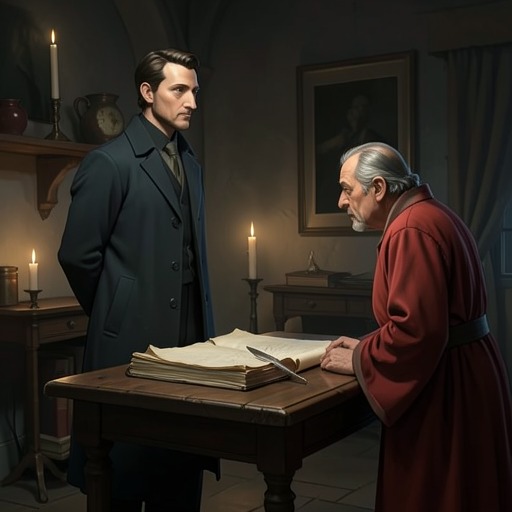
Henry VIII
Wolf HallHenry VIII is the king whose desire for a male heir drives the novel’s central conflict over his marriage to Katherine of Aragon and the limits of papal authority. His efforts to have that marriage declared invalid begin as a dynastic and scriptural question, but become a struggle over who may make law in England: the Pope, the Church, the king, or Parliament. As his dependence on Cardinal Wolsey gives way to a more direct exercise of royal power, Henry’s private wishes become instruments of institutional change.
The heir and the marriage question
Wolsey describes Henry as a man in his mid-thirties, in good health and prosperous circumstances, yet dissatisfied because he has no son to succeed him. The king’s daughter, Mary, does not resolve that anxiety: in the scriptural argument presented at court, children are understood to mean sons. Henry looks to the biblical tension between Deuteronomy, which recommends marrying a deceased brother’s wife, and Leviticus, which forbids it. The marriage had been granted a papal dispensation, but Henry now treats the possibility that it was unlawful as a way to seek its annulment.
The question carries the history of repeated hopes and losses. Katherine and Henry have lived through several pregnancies; a son known as the New Year’s prince survived only fifty-two days, another boy died within an hour, and other pregnancies ended in miscarriage or the brief life of a daughter. Mary, born in 1516, is the child who survives. Wolsey remembers the dead prince as a loss that might have made Henry a more contented Christian, while the continuing absence of a male heir intensifies the king’s demand for a new solution.
Wolsey’s account of Henry’s position is complicated by his loyalty to the king. He says that Henry once resisted doubts about the marriage, but now speaks of eighteen years spent in error and of sin needing expiation. In a private conversation with Katherine, Henry presents himself as regretting the impediment between them and says that, if the law allowed it, he would choose her again. His stated affection does not soften the central fact: he wants a declaration that their marriage never existed, and Katherine refuses to accept that premise.
Wolsey’s plans and the limits of influence
Wolsey tries first to manage Henry’s wish through counsel and procedure. He warns that pursuing an annulment could bring trouble and expense, and considers sending Stephen Gardiner to sound out the Roman Curia. Thomas Cromwell advises that the mission would be quickly understood in Rome and that cardinals would expect substantial money rather than promises. Wolsey also entertains a domestic route: convene a court in London, put Henry in the position of having to answer for an unlawful marriage, and see whether the king truly wants to proceed.
The cardinal’s diplomacy keeps several possible futures open. He considers a French marriage for Henry if the dispensation is revoked, even as he tries to preserve the existing marriage and England’s relationship with Katherine’s Spanish-Imperial family. In another plan, he imagines crossing to Calais and France, then gathering cardinals at Avignon to conduct church business while Pope Clement is in the Emperor’s custody. Such a council might decide Henry’s case before the Pope could act. Wolsey’s constant recalculation expresses both his political skill and the weakness of a policy built around anticipating the king: he once predicted what Henry would do, then spoke of what they would do together, and finally declares what he himself will do.
Henry’s will frustrates even those who believe they understand it. Looking back on Anne Boleyn’s thwarted attachment to Henry Percy, Cromwell and George Cavendish consider the possibility that the king’s intervention against the match concealed an earlier interest in Anne. In the later crisis, Anne herself refuses to accommodate Henry simply because he has chosen her. The king’s desire is powerful, but it does not guarantee the obedience or outcome he expects.
Parliament, revenue, and royal authority
By 1531, Henry’s marriage dispute is bound to the transformation of church government. Katherine tells Cromwell that the king’s ministers are using the praemunire laws against the clergy and demanding a payment of more than one hundred thousand pounds, which she calls extortion rather than a benevolence. She also challenges the claim that Henry can be induced by his councillors, arguing instead that he may be enticed. Cromwell insists that the king cannot simply be led, even as he presents royal supremacy as a position that can be defined and redefined.
In the spring of 1532, Parliament considers measures directed against the Church’s jurisdiction and revenues. Henry presses the clergy to recognize him as their sovereign rather than owe obedience to the Pope. Cromwell works through amendments with Rafe Sadler and Call-Me-Risley, while Stephen Gardiner leads resistance among the prelates. The proposed reforms are not only an argument about doctrine: they are legislation designed to restrict payments to Rome and make the king’s supremacy effective in practice.
Henry takes an active role when the Commons considers suspending annates, the payments made to Rome. Cromwell calls for a division of the House, a striking procedure that lets the king see who supports the bill and who opposes it. Henry gives his councillor a grim nod when the count is complete. In the Lords, the same method is insufficient, and the king goes in person three times to argue his case. The sequence shows royal authority being built through parliamentary process, observation of political loyalties, and direct persuasion rather than through a single declaration.
The king and competing accounts of law
In 1534, Cromwell presents Henry with propositions drawn from Marsiglio of Padua. They argue that Christ did not establish papal political power, grant priests a right to tax or legislate, or make the Pope the source of princes’ authority. In this account, priests remain subjects, while a prince governs the civil status of his citizens, including marriage and legitimacy. The king derives his kingship through a legislative body acting for the people, and Parliament may provide for the clergy and direct church wealth toward public benefit.
Henry listens with interest and carries the reasoning beyond the careful process Cromwell had intended. He suggests that shrines might be broken, turning an argument about legal authority and the disposition of church wealth toward the physical possibility of dismantling religious objects. Cromwell follows the king’s lead, while recognizing that Henry has moved more quickly toward action than the explanation was meant to require.
The contrast between royal and ecclesiastical jurisdiction remains explicit in Katherine’s resistance. She declares that salvation lies within the Church and warns that even kings face judgment; Henry, in her view, fears excommunication. Thomas More later draws a distinction between Parliament’s power over temporal matters and the spiritual jurisdiction he believes lies beyond the realm. When Richard Riche reports this distinction to Cromwell, the exchange exposes a basic conflict: Parliament can alter worldly authority, but the question of whether it can determine spiritual authority is disputed. Henry’s supremacy rests not merely on his personal will but on a claim that English institutions can settle matters previously referred to Rome.
Succession and political intimacy
Henry’s marriage to Anne Boleyn does not remove succession from public argument. When the king reviews a bill intended to secure the succession of Anne’s children, Anne reads the draft over his shoulder and is alarmed to find that it anticipates her death. Cromwell explains that Parliament can provide for contingencies, while Henry reassures her that the provision is not a prediction. Anne sees the implication clearly: if she dies without delivering a child, the king may take another queen. Her reaction shows how the legal machinery of succession reaches into the intimate security of the marriage itself.
Henry’s dealings with Anne are also presented as public performance within private proximity. She rides and hunts with him, reads documents at his shoulder, and turns the king’s friends into her own. Gardiner, present while they examine the succession bill, watches their closeness with discomfort. The scene places affection, political influence, and dynastic planning in the same room: Anne is both the king’s beloved wife and the mother whose children the law is being asked to protect.
Henry’s character emerges through these reversals. He can listen to legal argument, press his own case in Parliament, and redirect a discussion toward measures his adviser had not yet proposed. Yet the repeated search for a son makes his private anxiety the pressure behind public legislation, while Katherine’s refusal and More’s distinction between temporal and spiritual power mark limits that royal command cannot simply erase. His significance lies in this conversion of dynastic desire into a contest over the institutions and laws of England.